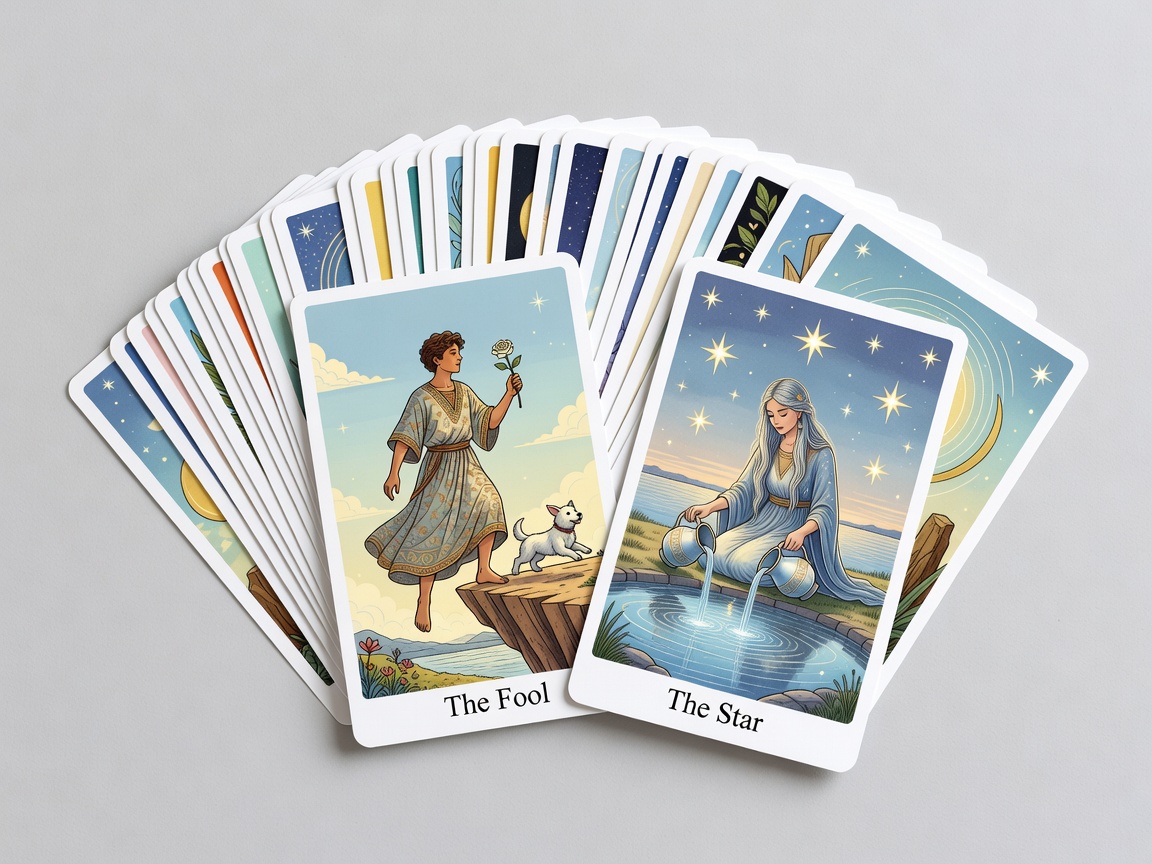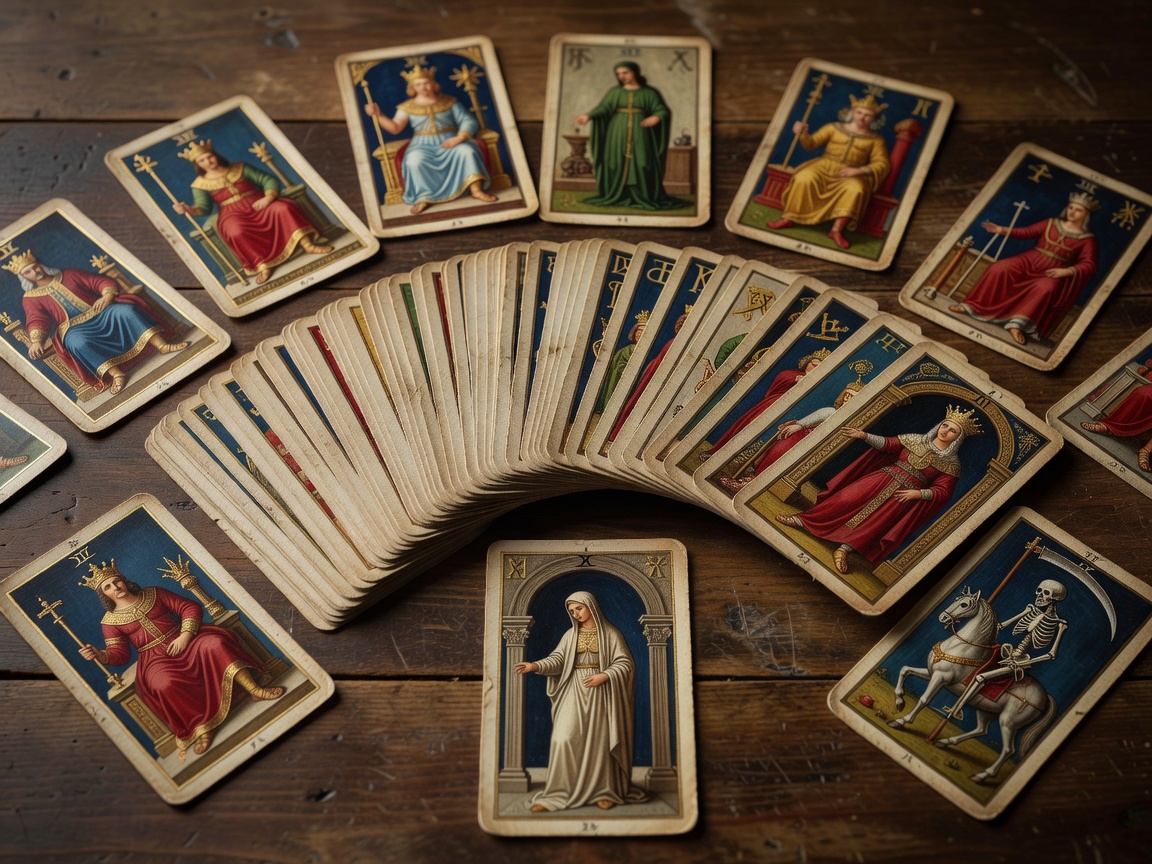
Tarot Symbolism & Iconography
Tarot speaks in a layered visual code — colour, number, animal, gesture and celestial body. Here's how to read it deliberately.
Tarot's images are rarely decorative. Most of what appears on a card — a colour, a posture, a background animal — was chosen to encode meaning, largely formalised in the late nineteenth century by occult societies who treated the deck as a portable textbook. Understanding this layered code turns a reading from "guessing at a pretty picture" into something closer to careful pattern-recognition.
A Working Symbol Glossary
| Symbol | Appears On | Common Meaning |
|---|---|---|
| White lily / rose | The Fool, The Magician | Purity of intent, focused will |
| Red rose | The Empress, Death | Desire and life force, active energy |
| Infinity symbol | The Magician, Strength | Unlimited potential, mastery beyond ordinary limits |
| Twin pillars (black/white) | The High Priestess, The Hierophant | Balance of opposites, a guarded threshold |
| Dog | The Moon, The Fool | Loyalty, the tamed instinctual mind |
| Lion | Strength, The Sun (chariot imagery) | Courage, power that has been tempered |
| Sun | The Sun, Judgement | Clarity, vitality, the conscious mind |
| Scales | Justice | Fairness, cause and effect |
| Still vs. turbulent water | The Star, The Moon, Cups pips | The state of the emotional or unconscious mind |
Numerology in Brief
Numbers carry meaning independent of suit or card name: One is unity and initiation; Two is duality and choice; Three is creative synthesis; Four is structure; Five is disruption; Six is harmony restored; Seven is reflection; Eight is mastery through repetition; Nine is near-completion, often tinged with anxiety; and Ten is culmination — the pattern resolved, for better or worse. This scale applies equally to Minor Arcana pips and to Major Arcana numbering.
The Golden Dawn's Kabbalistic Layer
The Hermetic Order of the Golden Dawn, active in London from 1888, assigned every Major Arcana card to a path on the Kabbalistic Tree of Life, and paired each card with a planet, zodiac sign, or element. The Star, for example, was assigned to Aquarius; The Empress to Venus; The Tower to the planet Mars. This correspondence system was later adopted, revised and made explicit in Aleister Crowley's Thoth Tarot, where astrological and Hebrew-letter titles are printed directly onto the cards rather than left implicit, as they are in the Rider-Waite-Smith deck.
Colour Across Three Traditions
| Tradition | Palette | Why |
|---|---|---|
| Rider-Waite-Smith (1909) | Flat primary colours, Arts & Crafts influence | Illustrator Pamela Colman Smith prioritised legible, teachable scenes |
| Thoth (1938–43) | Prismatic, electric, deliberately intense | Crowley wanted colour to bypass rational analysis and provoke intuition |
| Tarot de Marseille | Yellow, red, blue and flesh tones only | Dictated by four-block woodcut printing technology, not symbolism |
Read Symbols in Context, Not Isolation
A symbol dictionary is a starting point, not a finish line. The same red rose means something different beside The Empress (creative abundance) than beside Death (life continuing through transformation). Strong readers cross-check a symbol against the card's position in the spread, the cards adjacent to it, and the actual question being asked — a discipline covered in more depth in our guide to traditional spreads. For the historical reasons these symbols were chosen in the first place, see our history of tarot.
Continue Exploring