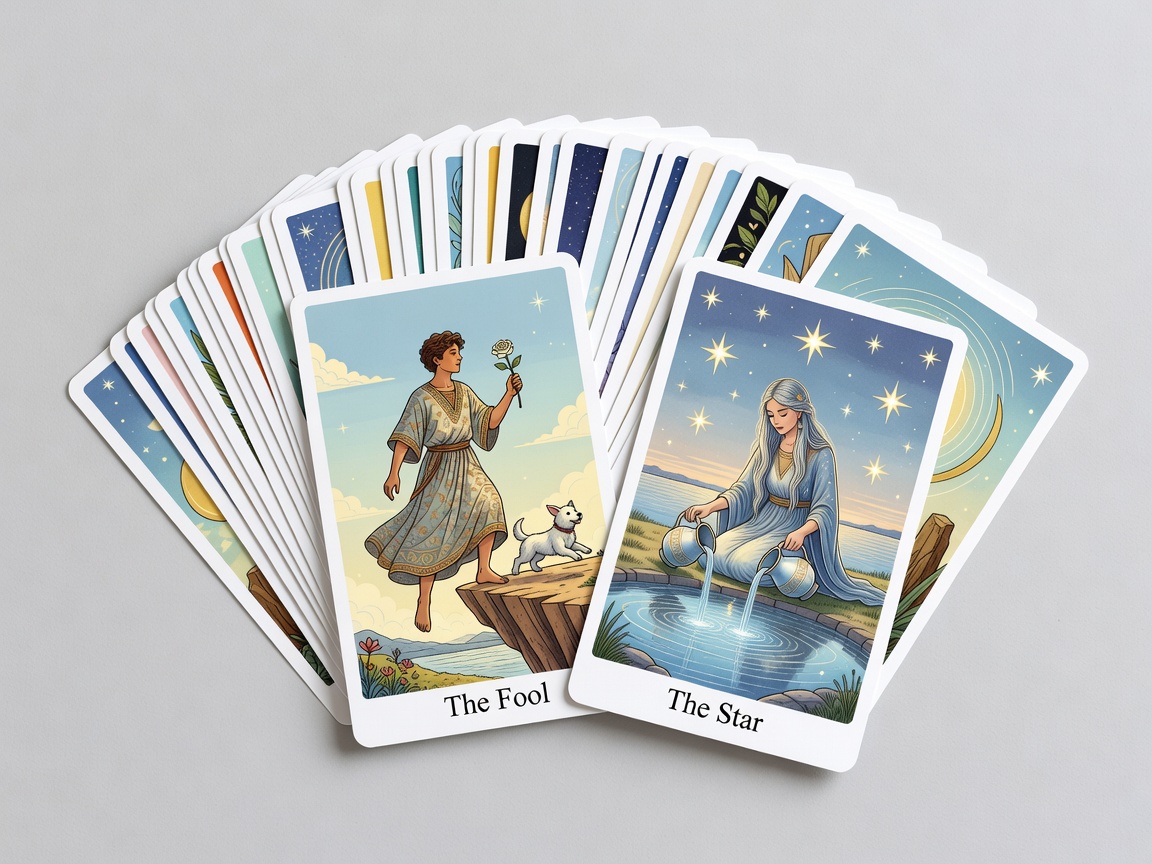
The Minor Arcana: Suits, Courts & Pips
56 cards across four suits carry the everyday texture of a reading — here is how they're organised, and how different decks render them.
The Minor Arcana make up 56 of the tarot's 78 cards: four suits of fourteen, structurally identical to a standard playing-card deck with an extra court position added. Where the Major Arcana describe life's turning points, the Minors describe its texture — a difficult conversation, a delayed payment, a moment of quiet relief. Learning the Minors well is largely a matter of learning one consistent pattern and applying it four times, once per suit.
Four Suits at a Glance
| Suit | Element | Realm | Astrology | Playing-Card Equivalent |
|---|---|---|---|---|
| Wands | Fire | Action, ambition, creativity | Aries, Leo, Sagittarius | Clubs |
| Cups | Water | Emotion, relationships, intuition | Cancer, Scorpio, Pisces | Hearts |
| Swords | Air | Intellect, conflict, communication | Gemini, Libra, Aquarius | Spades |
| Pentacles | Earth | Work, money, health, the body | Taurus, Virgo, Capricorn | Diamonds |
One Numeric Pattern, Four Ways
Each suit runs Ace through Ten, and the number itself carries a stable meaning regardless of suit: Ace (a pure beginning), Two (choice or balance), Three (initial growth), Four (stability, sometimes stagnation), Five (conflict or loss), Six (recovery), Seven (assessment), Eight (mastery through repetition), Nine (near-completion, often anxious), and Ten (culmination, for better or worse). Learn this ladder once and you can read a Two of Cups (a new emotional connection) and a Two of Swords (a difficult decision avoided) using the same underlying logic, adjusted only by element.
The Court Cards
Each suit adds four court cards: Page (a student or messenger, associated with news and learning), Knight (pursuit and action, sometimes impulsive), Queen (mastery of the suit's element turned inward), and King (mastery of the suit's element turned outward, toward authority or leadership). Readers disagree, reasonably, about whether courts represent actual people in the querent's life, aspects of the querent's own personality, or simply a style of energy moving through the situation — most experienced readers use context, not a fixed rule, to decide.
Illustrated Scenes vs. Geometric Pips
| Style | Example Deck | Pros | Cons |
|---|---|---|---|
| Illustrated scenes | Rider-Waite-Smith | Faster, intuitive reading for beginners | Can anchor interpretation too literally to the picture |
| Geometric pips | Tarot de Marseille | Builds genuine numerology & elemental fluency | Requires memorised meanings; slower to learn |
| Mixed symbolic | Thoth Tarot | Rich esoteric detail per card | Titles diverge from common usage (e.g. "Lust" for Strength) |
A Note on Suit Names Across Cultures
Historic Italian decks used Coins, Batons, Cups and Swords; Spanish-suited decks use Oros, Bastos, Copas and Espadas — variants of the same four-suit logic. French card-makers, driven by manufacturing convenience rather than symbolism, eventually replaced the four Tarot suits entirely with Hearts, Diamonds, Clubs and Spades for ordinary card games, which is why supermarket "tarot" novelty decks are sometimes just standard playing cards with a fifth suit bolted on rather than a true 78-card tarot.
Once the suits are familiar, the next step is learning how their elemental character combines with the Major Arcana in a live reading, and how recurring imagery across both arcana is decoded in our symbolism guide.
Continue Exploring
Traditional Spreads
See how Minor Arcana cards behave inside a full ten-card Celtic Cross.
Compare spreads →