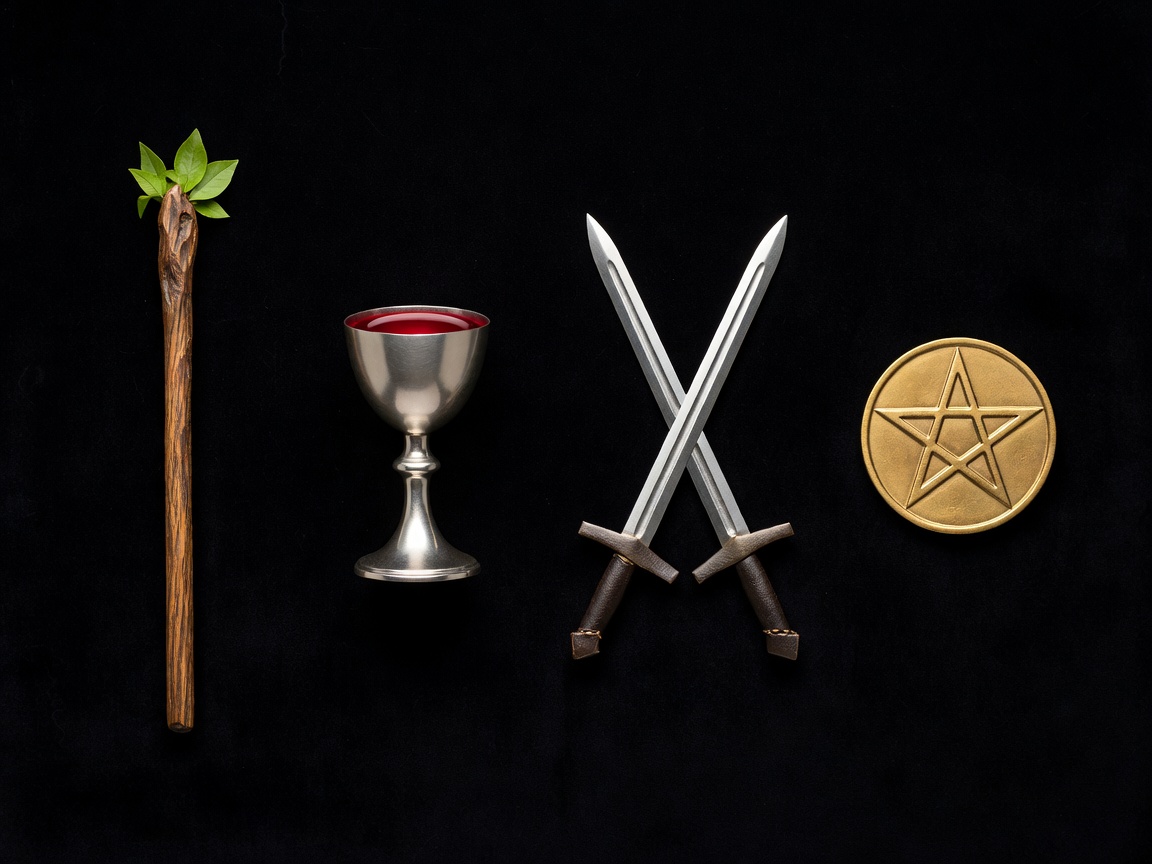
Minor Arcana
The 56 cards that fill in the day-to-day detail behind every Major Arcana theme.
Read the guide →The twenty-two "trump" cards that carry a reading's biggest themes — numbered, defined, and compared across four major decks.
Of the tarot's 78 cards, the twenty-two Major Arcana carry the most weight in a reading. Where the Minor Arcana track the weather of daily life — money, conversation, small victories — the Majors describe the seasons: forces that reshape a life rather than simply pass through it. Nineteenth-century occultists called them "trumps," a term borrowed from the trick-taking card game tarot descended from, and it still fits. When two or more Major Arcana appear in a single spread, most experienced readers agree the question at hand has stopped being small talk.
Since the early twentieth century, readers have grouped the Majors into a loose narrative called the Fool's Journey: cards 0–7 track the self stepping into the world (innocence, will, intuition, structure), 8–14 track the self tested by experience (courage, introspection, fate, consequence), and 15–21 track dissolution and rebuilding (temptation, upheaval, and eventual integration). It is a teaching device rather than a historical fact — the deck was not designed as a single story — but it remains the fastest way to memorise what each card contributes to the whole.
| No. | Card | Upright | Reversed |
|---|---|---|---|
| 0 | The Fool | New beginnings, faith in the leap | Recklessness, hesitation |
| I | The Magician | Willpower, resourcefulness | Manipulation, untapped talent |
| II | The High Priestess | Intuition, hidden knowledge | Secrets withheld, disconnection |
| III | The Empress | Abundance, nurturing | Creative block, dependence |
| IV | The Emperor | Structure, authority | Rigidity, control |
| V | The Hierophant | Tradition, shared belief | Rebellion, unconventional paths |
| VI | The Lovers | Union, aligned values | Misalignment, avoidance |
| VII | The Chariot | Willpower, direction | Lack of direction, aggression |
| VIII | Strength | Courage, quiet resolve | Self-doubt, misused power |
| IX | The Hermit | Introspection, guidance | Isolation, withdrawal |
| X | Wheel of Fortune | Cycles, turning points | Resistance to change |
| XI | Justice | Truth, cause and effect | Dishonesty, unfair outcomes |
| XII | The Hanged Man | Surrender, new perspective | Stalling, martyrdom |
| XIII | Death | Transformation, endings | Fear of change, stagnation |
| XIV | Temperance | Balance, patience | Excess, discord |
| XV | The Devil | Bondage, temptation | Breaking free, awareness |
| XVI | The Tower | Sudden upheaval, revelation | Avoided disaster, delayed change |
| XVII | The Star | Hope, renewal | Despair, disconnection |
| XVIII | The Moon | Uncertainty, the subconscious | Clarity emerging, released fear |
| XIX | The Sun | Vitality, success | Temporary setback, low energy |
| XX | Judgement | Reckoning, rebirth | Self-doubt, avoided calling |
| XXI | The World | Completion, integration | Unfinished business, delay |
Look closely and you'll notice Strength and Justice swap positions depending on the deck. The historic Tarot de Marseille lists Strength as XI and Justice as VIII. In 1909, A.E. Waite deliberately reversed the order for the Rider-Waite-Smith deck so the sequence would align with the zodiac: Strength (Leo) sits at VIII and Justice (Libra) at XI, matching each sign's position relative to the astrological wheel used by the Hermetic Order of the Golden Dawn. Neither numbering is "wrong" — they simply reflect two different priorities, one preserving the older printed sequence and one prioritising esoteric correspondence.
| Deck | First Published | Approx. Price | Best For | Trade-off |
|---|---|---|---|---|
| Rider-Waite-Smith | 1909 | $12–$18 | Beginners & universal reference | Imagery reflects Edwardian-era norms |
| Tarot de Marseille | 18th-c. pattern, modern reprints | $15–$22 | Traditionalists & pattern readers | Non-illustrated pips demand memorisation |
| Thoth Tarot | 1969 (painted 1938–43) | $28–$35 | Serious esoteric students | Dense astrological/Kabbalistic symbolism |
| Wild Unknown | 2012 | $30–$40 | Intuitive, nature-led readers | Departs furthest from classical iconography |
A spread dominated by Major Arcana tends to describe a period of consequence rather than a passing mood — good practice is to note how many Majors appear before reading individual cards, since three or more suggests the question sits inside a larger arc. When a Major lands beside supporting Minors, read the Major as the theme and the Minors as the practical detail underneath it. For a full walkthrough of how position changes meaning, see our guide to traditional spreads, and for the numeric and elemental cards that pair with these archetypes, visit the Minor Arcana guide.
The 56 cards that fill in the day-to-day detail behind every Major Arcana theme.
Read the guide →
Colour, number and Kabbalistic correspondence, decoded card by card.
Decode the symbols →